Biography of Péter Kozma
Key facts
- Péter Kozma (also written Peter Kozma; Hungarian: Kozma Péter) was a Swiss-Hungarian alpine skier, Olympian, visual artist and light artist.
- He was born on in Solothurn, Switzerland, and died on in Basel, at the age of 62.
- Competing for Hungary, he finished 18th in the slalom at the Winter Olympics in Sarajevo.
- From 1990 he hosted gatherings on the land at Frankhegy near Budapest; these became the Frankhegy Festival of electronic music and contemporary art (1995–2002).
- With Dóra Berkes he developed Raypainting (start: 1996): hand-painted glass plates projected onto buildings and landscapes with high-power Pani projectors.
- From 2006 to 2010 he created large-scale light art installations of his own, in Essen, Warsaw, Duisburg, Zürich, Budapest, Helsinki and Eindhoven, among other places.[1][2]
Family and childhood
His full name was Peter Thomas Kozma.[3]
His parents, Dr. Ottó Kozma and Zsuzsanna Bókay, were Hungarian emigrants who left the country in 1956. Kozma was born in Switzerland and spent his childhood in Solothurn and in Ticino, in southern Switzerland, where his interest in nature and biotopes began, and later in Zürich.[1]
In his own account, his father came from a dynasty of dentists and studied dentistry in Zürich; his mother, from a well-known family of physicians, studied biology at the Sorbonne. The family's large plot in Ticino, with meadows, woods and a stream, gave him his first experience of a self-contained living space, which he says echoes in his later light installations. He describes his mother as a multiple Hungarian ski champion and his father as a ski jumper.
Suzanne Bókay-Kozma, a ceramicist working in raku technique, was born in 1932 in Budapest; she left Hungary in 1956, took a doctorate in Paris, married in 1960 and moved to Switzerland.[4]
According to Népszava, his parents always spoke Hungarian with him when he was a child, and the family spent many holidays at Lake Velence.[3]
His friends called him "Kozi".[5]
Languages he spoke: English, German, Italian, French, Hungarian.[2]
Studies
He studied medicine for two years at the University of Zürich while competing in sports at a professional level. In 1985 he moved to Budapest and studied at the Faculty of Architecture of the Budapest University of Technology and Economics (length of study: four years). From 1989 he studied at the Hungarian University of Applied Arts, now MOME (department: Visual Communication). His teachers included Erika Katalina Pásztor, János Szirtes and Dóra Maurer. He obtained his diploma in 2001.[1]
Népszava writes that after moving to Budapest he became more and more interested in culture and visual art; among other things he made striking installations for concerts of the band Vágtázó Halottkémek (VHK).[3]
Sport
He began skiing at the age of three, was a member of the Swiss University Ski Team in 1981, joined a Swiss team in 1982 (Swiss National Junior Team) and competed for Hungary from 1983. At the 1984 Winter Olympics in Sarajevo he finished 18th in the slalom. See Sport career.[1]
Frankhegy and light art
In 1987 a plot of land on Frankhegy, in the Buda hills at the edge of Budapest, was bought (by: he and his family); there he realised a "biotope project" and land art. From 1990 the site hosted private gatherings and later the public Frankhegy Festival (1995–2002). See Frankhegy.[1]
He divided his light art into two eras: Raypainting, created with Dóra Berkes, and the later Light Art Installation projects (2006–2010), in which he turned to digitally created images and to the concept of Augmented Space. See Light art and Works.[1]
Later life and death
He withdrew from creating light art (after 2010). His interest turned toward somatics, yoga and spiritual philosophy; he interpreted the body itself as a kind of 3D biotope. He died in November 2023 in Basel at the age of 62.[1]
According to Népszava, he later turned, among other things, to postmodern dance, and then to somatics.[3]
Portrait
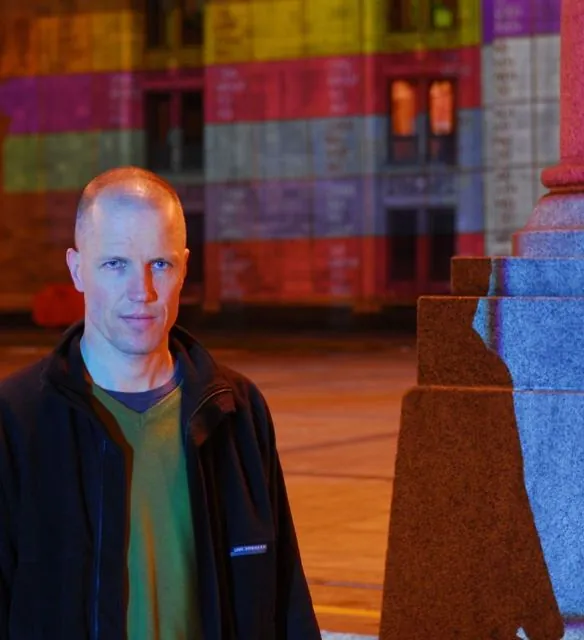
Peter Kozma, Warsaw, 2006. Photo: Zsolt "Lovacska" Fekete
Timeline
- His parents, Ottó Kozma and Zsuzsanna Bókay, leave Hungary with hundreds of thousands of others; their first stop is Padua.[1]
- His mother completes her biology studies at the Sorbonne in Paris and follows his father to Solothurn, where they marry.
- Born in Solothurn, Switzerland. A few years later the family moves to Zürich.[1][2]
- Skis from the age of three; from 14 he races in alpine events.[1]
- The family moves near Zürich; in the garden he builds a pond as a self-contained biotope. Earlier his parents had bought a large, wild plot in Ticino, which he describes as decisive for his later art.
- Member of the Swiss University Ski Team. He studies medicine for two years at the University of Zürich.[1]
- Joins a Swiss team: Swiss National Junior Team.[1]
- Starts competing for Hungary.[1]
- 18th in the slalom at the Winter Olympics in Sarajevo.[1]
- Moves to Budapest and enters the Faculty of Architecture of the Budapest University of Technology.[1]
- The plot on Frankhegy is bought (by: he and his family); a biotope project and land art begin there. He ends his competitive skiing career the same year.[1]
- Continues his studies at the Hungarian University of Applied Arts (now MOME). Teachers: Erika Katalina Pásztor and János Szirtes; he takes part in Dóra Maurer's course, experimenting with small slide projectors.[1]
- Private art gatherings and parties for friends at Frankhegy.[1]
- Frankhegy Festival (1995–2002): multi-day, multi-venue events open to the public, combining electronic music and visual art.[1]
- First light installations at Frankhegy; according to his own account the name Raypainting is born (start of Raypainting: 1996). Collaboration with Dóra Berkes; shows in Switzerland from the autumn.[6]
- Meets Gerry Hofstetter, the duo's manager until 2001. Raypainting at Colombier with twelve 1,500 W Pani projectors (year of Colombier: 1997).
- Diploma from the Hungarian University of Applied Arts. At Christmas, first major commission in Budapest: the T-Com headquarters and the park in front of it.[1]
- Designs the Raypainting tower; Raypainting on 20,000 m² at Millenáris Park for Hungary's EU accession.[6]
- Last Raypainting project, at the Brandenburg Gate and Pariser Platz in Berlin. Solo installations follow: Komárom, Essen, Duisburg, Warsaw, Budapest.
- Zürich Lichtfest; Journey on the Datascape and Sputnik Day at Vajdahunyad Castle; m.city at the Hungarian Academy of Sciences.
- Timescan in Helsinki. Writes his autobiographical "curriculum vitae in the form of a short story" (Stumpf, 2008).
- Rolling at the GLOW festival in Eindhoven, his last light art installation project.
- Dies in Basel, aged 62.[1][2]
Source keys in brackets refer to the list of sources below.
